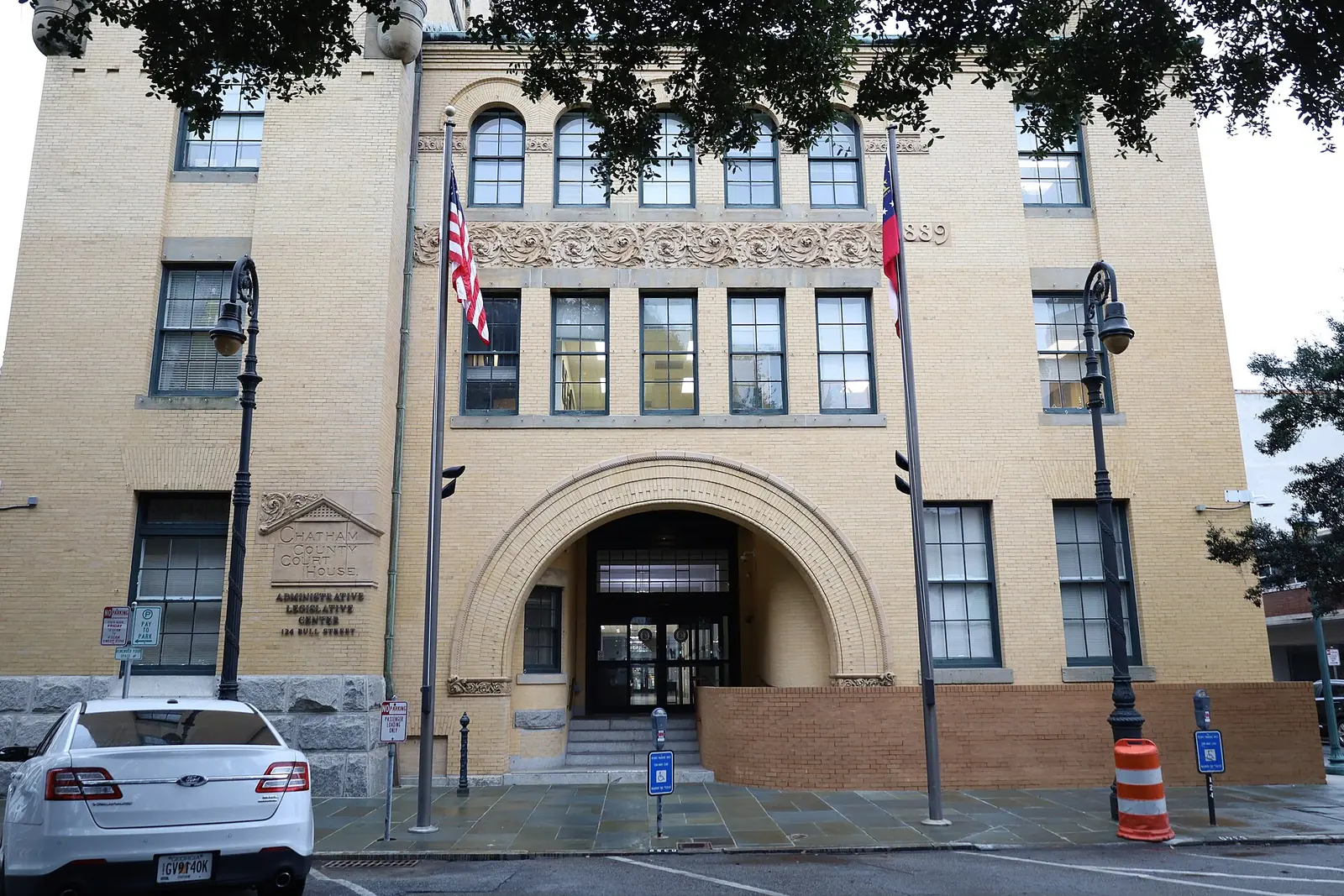
Savannah owners get two tax bills: Chatham County's, due Nov. 15, and the city's, due mid-November. Values and appeals: Board of Assessors, 912-652-7271.
Last checked Oct. 6, 2026. Facts come from the Chatham County Tax Commissioner, the Chatham County Board of Assessors and the City of Savannah’s Property Tax Division.
If you own a home inside Savannah city limits, you pay property tax to three bodies: Chatham County, the Savannah-Chatham County Public School System and the City of Savannah. They come on two separate bills. The Chatham County Tax Commissioner bills and collects the county and school taxes. The City of Savannah Revenue Department bills and collects city taxes on its own.
Who to call
- Your value, exemptions or an appeal: Chatham County Board of Assessors, 912-652-7271, 222 W. Oglethorpe Ave., Suite 113, 8 a.m. to 5 p.m. weekdays
- County and school tax bill or payment: Chatham County Tax Commissioner, 912-652-7100; view and pay online
- City of Savannah tax bill: Revenue Department Property Tax Unit, 912-651-6455, 305 Fahm St., 8:15 a.m. to 5 p.m. weekdays
Due dates
County and school taxes. The Tax Commissioner bills real estate in two installments, according to its property tax FAQ:
| Installment | Billed | Due |
|---|---|---|
| First (about half of last year’s total) | April 1 | June 1 |
| Second (this year’s values, exemptions and rates) | Sept. 15 | Nov. 15 |
Interest is charged every 30 days starting Nov. 16, and penalties are added every 120 days after that, up to 20%. A U.S. Postal Service postmark dated by midnight on the due date counts as on time. Mobile homes are billed Feb. 1 and due April 1.
City taxes. The city also bills in two installments. The first is billed in April and is typically due in mid-June; the second is billed in September and is typically due in mid-November, according to the city’s property tax FAQ. The exact date is printed on the bill. The city accepts partial payments up to the second due date but does not make payment plans.
Not getting a bill does not excuse a late payment. Download a county bill at chathamtax.org and a city bill through the city’s property tax page.
How the bill is figured
Georgia taxes property at 40% of fair market value. Exemptions come off that assessed value, and the result is multiplied by each body’s millage rate. One mill is $1 for every $1,000 of taxable value. The city’s own worked example, from its calculating property taxes page:
- Fair market value $100,000 x 40% = $40,000 assessed
- Less a $2,000 homestead exemption = $38,000 taxable
- $38,000 x 12.739 mills (the 2021 city rate) = $484.08 in city tax
County and school taxes are figured the same way on the county bill.
2026 rates
The rates below are the ones each government advertised in July 2026 before its final vote; the adopted rates print on your second-installment bills.
| Levy | 2026 rate advertised | Rollback rate |
|---|---|---|
| City of Savannah | 11.749 mills (same as 2025) | 11.402 mills |
| Chatham County general (maintenance and operations) | 10.518 mills | 10.188 mills |
| Chatham Area Transit | 0.940 mills | 0.910 mills |
Sources: the City of Savannah’s July 2, 2026, release and the County Commission’s notice of property tax increase. Georgia law calls any rate above the rollback rate a tax increase, even when the rate itself does not change. The county’s Special Service District rate applies only in unincorporated Chatham County, not inside Savannah. The school board sets its own rate.
Savannah’s city rate over time
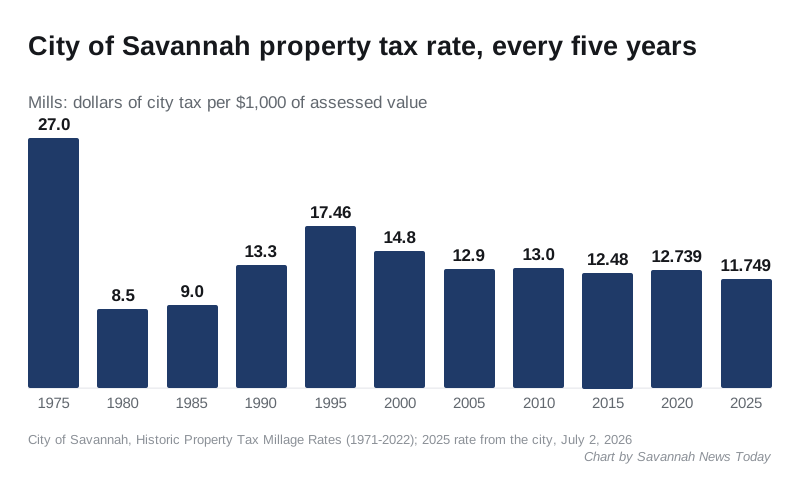
The city’s 2025 and proposed 2026 rate of 11.749 mills is its lowest since 1987, according to the city’s historic millage table and its July 2026 release.
Homestead and Stephens-Day exemptions
You qualify for a homestead exemption if you own and live in the home as your permanent residence on Jan. 1, according to the Board of Assessors. Rental property does not qualify, and you get only one homestead.
- Deadline: applications filed by the 45-day appeal deadline on that year’s assessment notice count for the current year. Online applications close April 1; after that, apply in person.
- What to bring: a Georgia driver’s license or ID card and the registration for vehicles in your name. Staff may also ask for a utility bill or voter card.
- Stephens-Day exemption: holds your taxable value at its value in the year before you applied, plus improvements. The school and city bills add a Consumer Price Index increase to that base.
- Special exemptions cover seniors, people with disabilities, 100% disabled veterans and surviving spouses, and include the city’s floating homestead and a tax deferral for the elderly. Ask the Board of Assessors which apply.
How to appeal
You can appeal only in response to your annual notice of assessment, and you have 45 days from the notice date printed on it, according to the Board of Assessors FAQ. Appeal forms are on the Board of Assessors site; the next step, if you disagree with the result, is the Board of Equalization.
- Owners whose 2026 notice came back undeliverable have until Wednesday, Oct. 21, to appeal, the Board of Assessors says.
- An appeal can remove an existing “299C” value freeze on your property.
- While an appeal is pending you still owe at least the billed appeal amount by the due date. The city bills a property under appeal at the lesser of last year’s value or 85% of the new value.
Where to pay county taxes
Pay online at chathamtax.org (e-checks are free; convenience fees apply to cards), by mail to Chatham County Tax Commissioner, P.O. Box 9827, Savannah, GA 31412, or in person at 222 W. Oglethorpe Ave., Suite 107, 1145 Eisenhower Drive, 295 Police Memorial Drive, 125 Wilmington Island Road, 7224 Georgia 21 or 8 U.S. 80.
What this means for you
- Watch for two bills, county and city, both due in mid-November.
- Check the 45-day deadline on your assessment notice if you think the value is wrong.
- New owners: file for homestead and Stephens-Day as soon as you move in.
Related: Savannah home prices and moving to Savannah.
Frequently asked questions
When are Chatham County property taxes due?
Chatham County bills in two installments. The first is billed April 1 and due June 1; the second is billed Sept. 15 and due Nov. 15. Interest starts Nov. 16.
Do Savannah residents pay city and county property taxes?
Yes. Homeowners inside Savannah city limits get a county bill from the Chatham County Tax Commissioner, which includes school taxes, and a separate city bill from the City of Savannah Revenue Department.
What is the City of Savannah millage rate?
The city’s adopted 2025 rate was 11.749 mills, its lowest since 1987, and the city proposed keeping 11.749 mills for 2026. One mill is $1 of tax for every $1,000 of assessed value.
How do I appeal my property value in Chatham County?
File with the Chatham County Board of Assessors within 45 days of the notice date on your annual assessment notice. Call 912-652-7271 or visit 222 W. Oglethorpe Ave., Suite 113.
What is the Stephens-Day exemption?
It is a Chatham County homestead exemption that holds your taxable value near its value in the year before you applied, plus improvements. City and school bills add a Consumer Price Index increase to that base value.
Have your say