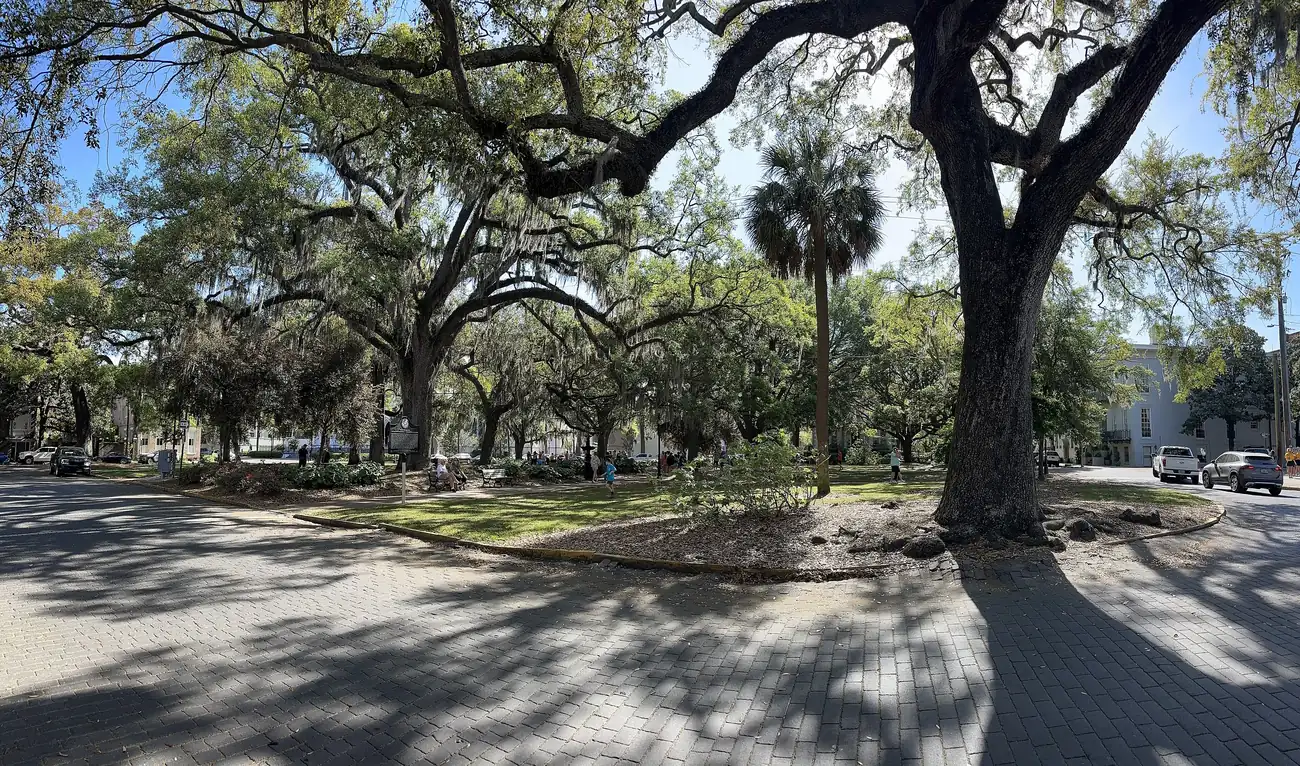
Savannah's Historic District, a National Historic Landmark since 1966: the squares, River Street, Plant Riverside, museums, parking and the free DOT shuttle.
Last checked Oct. 6, 2026. History comes from the National Park Service; hours, addresses and transportation come from the City of Savannah, Savannah’s Waterfront, Chatham Area Transit and each venue’s own site, linked below.
Savannah’s Historic District is the city James Oglethorpe laid out in 1733, a grid of streets and wards built around tree-shaded squares on a bluff over the Savannah River. The National Park Service calls it one of the few surviving colonial city plans in the United States, and it has been a National Historic Landmark since 1966. River Street runs along the water below the bluff.
The district at a glance
- Founded: 1733, on the Oglethorpe Plan
- National Historic Landmark: since 1966
- Get around free: DOT shuttle, every 10 minutes, 18 stops
- River Street Visitor Information Center: 1 W. River St., 10 a.m. to 6 p.m. daily
- City parking questions: Mobility and Parking Services, (912) 651-6470
The plan and the squares
Oglethorpe and 114 settlers arrived in 1733 and chose a high bluff over the river for the town. According to the National Park Service, he based the design on English planning principles: a grid of streets, wards and “trustee lots” broken up at regular intervals by park-like squares. As the city grew the pattern was repeated, and it stayed the city’s framework through the 18th and 19th centuries.
The Secretary of the Interior designated the Savannah National Historic Landmark District in 1966. The Park Service names the Oglethorpe Plan and the collection of buildings on it as the qualities it monitors.
Troup Square carries the historical marker for “Jingle Bells” composer James L. Pierpont, and Forsyth Park has the fountain, the playground and the Saturday farmers market; see our parks and trails guide.
Dogs must be leashed in every square under the city’s leash law.
River Street and the waterfront
Savannah’s Waterfront covers River Street from Plant Riverside District in the west to The Park at Eastern Wharf in the east.
- Driving: River Street is one-way, west to east. Take Martin Luther King Jr. Boulevard north and turn right, or use the cobblestone Barnard, Bull, Abercorn, Lincoln and East Broad Street ramps from Bay Street.
- Parking: the Plant Riverside Garage, 500 W. River St., and the Eastern Wharf Parking Garage, 301 Passage Way, are open 24 hours and take cards only. There are city lots at the Barnard, Abercorn and Lincoln ramps.
- Elevators from Bay Street: at The Alida, 412 Williamson St.; between the Hyatt Regency and City Hall at Bull and Bay streets; and at the AC Hotel, 601 E. River St.
- River Street Visitor Information Center, 1 W. River St., at the foot of the Bull Ramp: open 10 a.m. to 6 p.m. daily, closed Christmas and New Year’s Day.
Plant Riverside District, 400 W. River St., at the west end, holds the Savannah Christmas Market every winter. Emmet Park on Bay Street holds Savannah’s Vietnam Veterans Memorial, dedicated in 1991 to the 106 Chatham County service members killed or presumed killed in the war.
The waterfront’s big free nights are the Lighted Boat Parade on Nov. 28, the Lighted Christmas Street Parade on Dec. 12 and the New Year’s Eve fireworks; see our Christmas parade page and New Year’s Eve page.
Museums
- Telfair Museums: the Jepson Center, 207 W. York St.; the Telfair Academy, 121 Barnard St.; and the Owens-Thomas House and Slave Quarters, 124 Abercorn St. Open 10 a.m. to 5 p.m. Tuesday through Sunday. One ticket covers all three for seven days, and the Jepson Center is free for local residents.
- Coastal Heritage Society: the Savannah History Museum, Battlefield Memorial Park, the Georgia State Railroad Museum and the Savannah Children’s Museum are together at Tricentennial Park by the Visitor Information Center. The Harper Fowlkes House, 230 Barnard St., gives guided tours. Hours are on the society’s hours and admission page.
Getting around
- DOT shuttle: CAT’s free downtown shuttle runs two loops, Forsyth and Downtown, with 18 stops every 10 minutes: 7 a.m. to 7 p.m. weekdays, 10 a.m. to 6 p.m. weekends.
- Savannah Belles Ferry: free, every 10 minutes from 7 a.m. to 10 p.m., to Hutchinson Island.
- City garages: Bryan Street (100 E. Bryan St.), Liberty Street (401 W. Liberty St.), Robinson Street (132 Montgomery St.), State Street (100 E. State St.), Whitaker Street (7 Whitaker St.) and Eastern Wharf (301 Passage Way). Questions go to Mobility and Parking Services.
Frequently asked questions
When was Savannah’s Historic District founded? In 1733, when Oglethorpe and 114 settlers laid out the town on the bluff.
Is Savannah’s Historic District a National Historic Landmark? Yes, since 1966.
Where do I park in downtown Savannah? In the six city garages, or the Plant Riverside and Eastern Wharf garages on River Street.
Is there a free way to get around the Historic District? Yes: the DOT shuttle and the Savannah Belles Ferry are both free.
What this means for you
- Park once in a garage and use the DOT to hop between the squares, museums and River Street.
- Use the elevators at The Alida, City Hall or the AC Hotel if the river stairs are too steep.
- Residents of Chatham County get into the Jepson Center free with proof of address.
Related: free things to do in Savannah, date night in Savannah, live music and nightlife and parks and trails.
Have your say