Savannah wants comments by Nov. 20 on its first data center rules: 1,000 feet from homes, a 50-decibel cap, no evaporative cooling. Council votes in January.
Savannah is asking residents to weigh in on the first rules it would write for data centers. A survey and comment form are open until Friday, Nov. 20.
The city said Wednesday it is considering a change to its zoning ordinance. The change would define data centers as a land use for the first time and set development standards for them. The City Council is expected to vote in January 2027.
The rules would arrive just before the end of a pause on large data centers. The City Council adopted the 155-day moratorium on Aug. 27 and held a second vote Sept. 10, according to the city’s data center page. The pause ends Jan. 29, 2027. It can be extended by up to 30 days if the process needs more time.
“Savannah must be prepared to understand what our infrastructure can and cannot accommodate, where the line exists between community benefit and community harm, and what is best for each of our neighborhoods,” Mayor Van R. Johnson II said in the city’s Oct. 28 news release.
The city said it has not received an application for a large data center while the moratorium has been in place. It noted that a very large data center has been proposed nearby in Effingham County, which borders Chatham County to the northwest.
What the draft would require
The city’s page sets out what the working draft says. Many details are still open, the city said.
Where they could go
- Only in industrial districts, and only with a special use permit.
- A special use permit needs public hearings before the Metropolitan Planning Commission and the City Council.
- At least 1,000 feet from homes, schools, parks, places of worship, libraries, child care centers and health care facilities.
- Property owners within 1,320 feet would get mailed notice of the hearings, and neighborhood meetings would be required.
Size
- Minor data centers are under 100,000 square feet.
- Major data centers are 100,000 to 500,000 square feet.
- Small, low-impact server rooms would face simpler rules.
- A converted warehouse would be classed by how much floor area is converted, and would go through the same hearings as a new building. The city called Savannah’s warehouses “the likely targets for conversion.”
Noise, water and power
- The applicant pays for an independent sound study before the hearing.
- Sound could not exceed 50 decibels at the nearest home or other noise-sensitive property, or the existing background level if that is lower.
- Facilities on city water would have to use closed-loop cooling or a similar water-saving method. Evaporative cooling would be banned.
- The city would confirm its treatment plant has room for the wastewater before approving a permit.
- Applicants would need a letter from the utility saying it can serve the project, and would have to show the cost of any grid upgrades is not shifted to existing customers.
Backup power and safety
- Backup power would come from batteries or other non-combustion sources lasting at least 10 hours.
- Diesel or other fossil-fuel generators could serve only as an emergency second backup, tested between 9 a.m. and 5 p.m. City staff is still weighing whether to ban them outright.
- The Savannah Fire Marshal would review each facility’s emergency response plan.
Looks, closure and community benefit
- A height limit of 75 feet, with brick, stone or architectural metal and a wide landscaped buffer.
- No razor wire or barbed wire.
- A decommissioning bond before opening, so the site can be cleaned up if it is abandoned.
- Major data centers would have to contribute infrastructure upgrades, reinvestment or other community benefits through a development agreement.
The city cannot set electric rates. Those are regulated by the Georgia Public Service Commission and Georgia Power, the city said, so its rules work through zoning conditions instead.
The city also said why it is not simply banning data centers. “A citywide ban carries legal risk,” its page says. A ban could also restrict existing server rooms at hospitals, schools and utilities.
On jobs, the city’s own summary is cautious. Data centers can bring private investment, tax revenue and construction jobs, the city said, but “they typically create few permanent on-site jobs.”
The key dates
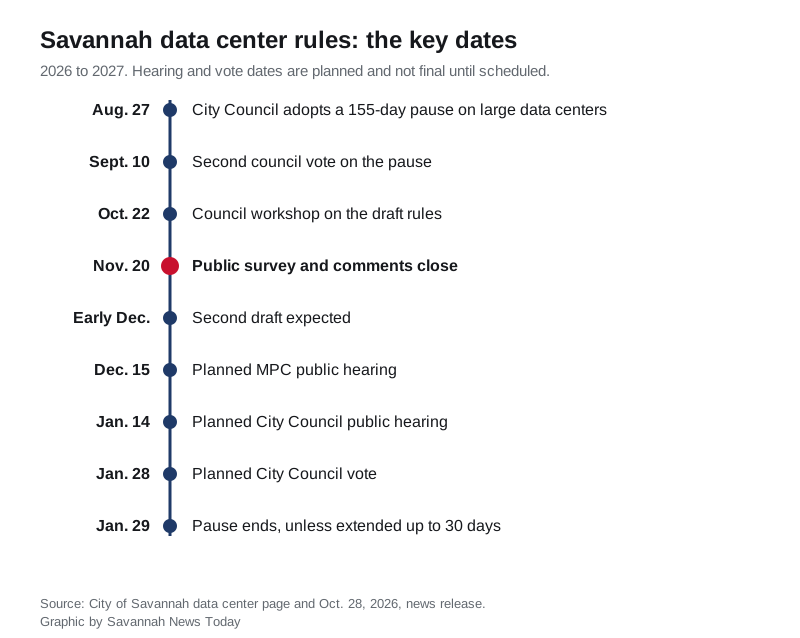
The City Council held a workshop on the draft Oct. 22. The city said a draft ordinance will be posted in November for review. Its page says a second draft is expected in early December.
After that, the planned schedule is:
| Date | Step |
|---|---|
| Tuesday, Dec. 15 | Metropolitan Planning Commission public hearing |
| Late December | Final draft to the City Council |
| Thursday, Jan. 14, 2027 | City Council public hearing |
| Thursday, Jan. 28, 2027 | City Council vote |
| Friday, Jan. 29, 2027 | Moratorium ends |
The city said hearing and vote dates are not final until they are scheduled.
The draft is being written by staff from the Chatham County-Savannah Metropolitan Planning Commission, Chatham County and three city departments: Policy and Intergovernmental Affairs, Planning and Economic Development, and Water Resources.
What it means for you
- Take the survey by Friday, Nov. 20. It is linked from the city’s data center page, and there is a direct survey link.
- Read the draft when it posts. The city said it will publish the draft ordinance in November for comment. We will add the link here.
- Speak at a hearing. Residents can speak before the Planning Commission and the City Council. If you live near an industrial district, watch for a mailed notice once a project is filed.
- Check what can be built near you. Our guide to building permits and zoning in Savannah explains how rezonings and special use permits work.
Have your say